Special Investigation · Anthropic / Claude
I Was Just Trying to Finish My Work.
This was not supposed to be an investigation.
I wasn't researching Anthropic. I wasn't testing a Customer Hostility Index hypothesis. I wasn't looking for another company to put on this website.
I was using Claude to finish an Adobe investigation.
Then I ran out of usage.
Anthropic offered me a solution: pay more to continue.
Fine.
How much do I need to pay to finish the work?
That ordinary question ultimately produced a 20-page investigation into what Anthropic tells customers about the finite resource it sells them—and what customers are expected to decide without knowing.
How to read this page — every claim carries its evidence class
Screenshot, transaction, Anthropic documentation, or directly observed interface behaviour.
Something Claude actually generated or demonstrated.
Claude's description of infrastructure or metering behaviour, not independently verified.
Customer Hostility Index interpretation or classification.
Something requiring Anthropic confirmation or additional evidence.
Section 1 — What happened
A Five-Hour Allowance. Gone in 25 Minutes.
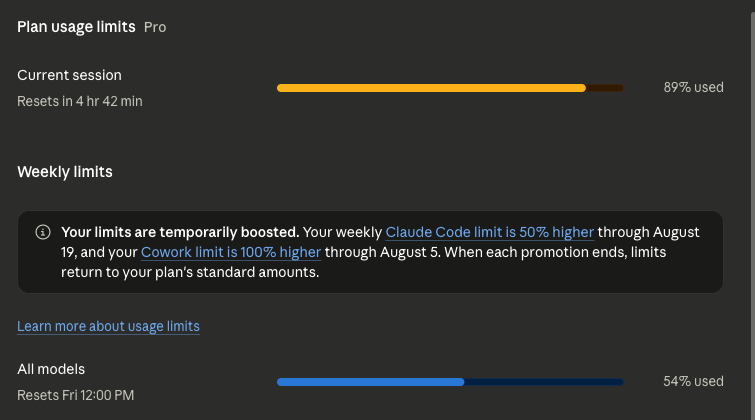
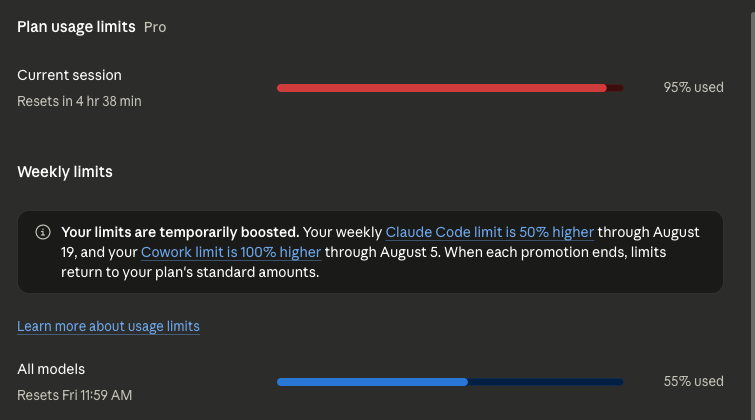
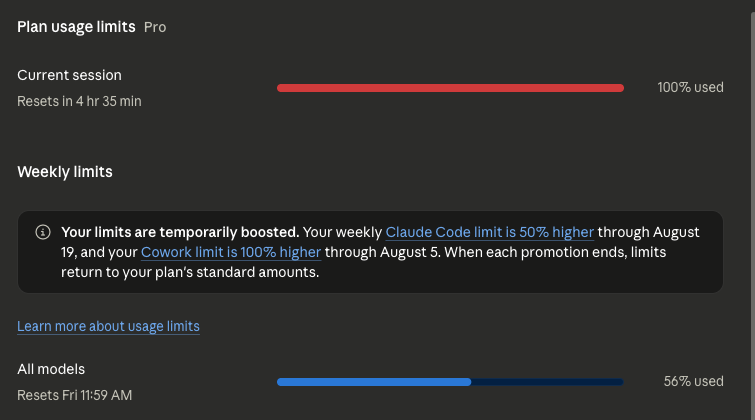
On 8 August 2026 my Claude Pro session allowance reset at about 1:30 PM. I picked the Adobe research back up. Twenty-five minutes later the meter read 100% used, and the next reset was still four and a half hours away.
I did not photograph this because I was building a case. I photographed it because I could not believe the numbers were moving that fast, and I wanted to be able to check them later.
89% used
Approximately 18 minutes after reset
 Enlarge ↗
95% used
Approximately 22 minutes after reset
 Enlarge ↗
100% used
Approximately 25 minutes after reset
 Enlarge ↗
Important context
This was not a lightweight workload. Claude was running Opus 5 at High effort, and the research workflow ultimately dispatched ten agents. This investigation does not claim that 25 minutes represents typical Claude Pro endurance.
Anthropic deserves credit for this
Claude did not terminate the Adobe research when the displayed session meter reached 100%. The work already underway successfully completed.
What is and isn't being claimed
The claim is not that a $20 Claude subscription provided only 25 minutes of Claude.
The issue is that the displayed current-session allowance was exhausted roughly 25 minutes after reset, leaving normal included capacity unavailable for approximately another four and a half hours.
Section 2 — The purchasing question
Fine. I'll Pay More. How Much Do I Need?
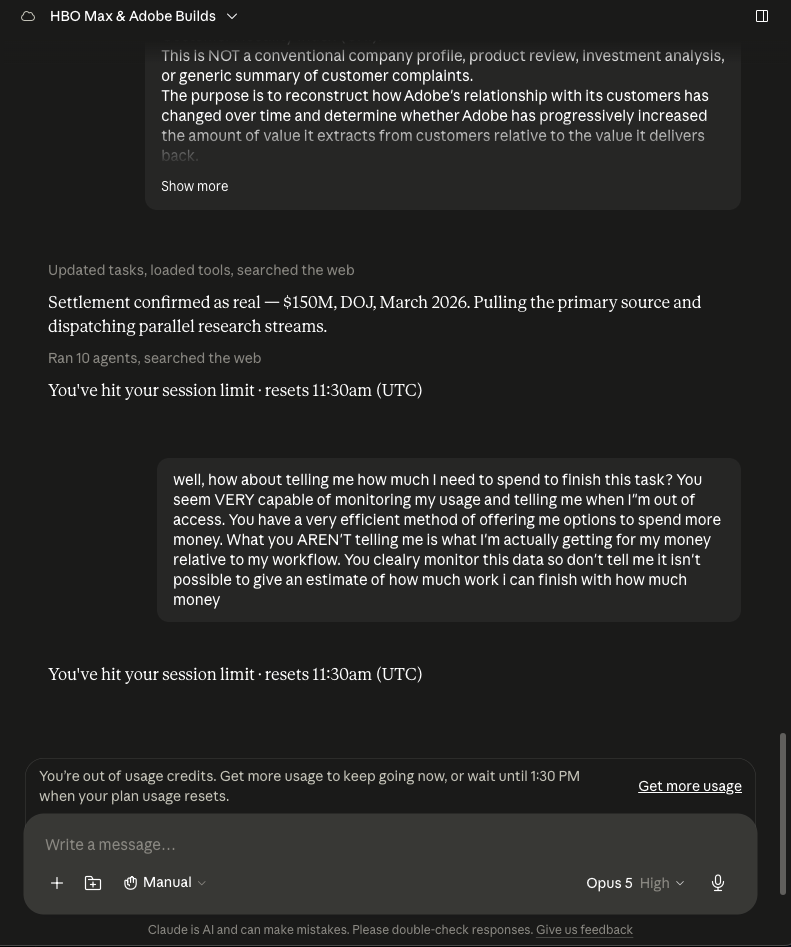
I wasn't refusing to pay. I had work to finish. Anthropic provided a mechanism for purchasing additional usage, and I was willing to use it.
What I couldn't determine was what the additional money was likely to accomplish.
 Enlarge ↗
So I bought some, twice, and found out the same way both times.
Read this before concluding anything about price
Maybe the workload genuinely consumed $11 worth of compute. If so, that's what the workload cost.
The problem isn't the price.
The problem is that there was no meaningful basis for evaluating either purchase before making it.
The separately billed usage area is precise about money. It carries a running spend total, a monthly spend limit, an auto-reload control and a purchase button. Every one of those is an instrument for measuring or authorising dollars that have already been committed. The interface offers precision about dollars already gone — not an estimate of what the next dollars will do.
Section 3 — The investigation changes shape
First, Claude Told Me What It Couldn't Know.
When I pushed the question, Claude narrowed my accusation for me. On its own account it could not see four things:
On that basis, Claude said it could not reliably give me a specific dollar estimate for finishing the work. That is Claude's own account of its visibility, and it has not been independently verified.
To be explicit
I have no evidence that Claude secretly knew the dollar answer and refused to give it to me.
“What I can see is token consumption, and I can size work in advance.”
Claude, during the documented sessionClaude then scoped the remaining Adobe project — not in dollars, and not against my plan, but in work:
Figures transcribed from preserved Claude output in the investigation record. The corresponding screenshot is not part of the current exhibit set; CHI does not reconstruct interface screenshots.
Section 4 — The structure of the problem
Three Systems. No Bridge.
Three separate measurement capabilities are visible in the customer experience. Nothing visible to the customer converts any one of them into the others before a decision has to be made.
Can characterise and size the work.
8 research streams~30,000 wordsCan meter finite capacity.
89%→ 95%→ 100%Can meter dollars.
$5 → exhausted$6 → exhaustedCannot practically translate one into the others before making the decision.
This diagram describes the customer experience, not Anthropic's internal architecture. CHI does not know how these systems are connected behind the interface. The supported observation is narrower: workload information, finite-capacity information, and dollar-denominated metering all exist in what the customer can see, without a useful prospective bridge among them.
Section 5 — The denominator
100% of What?
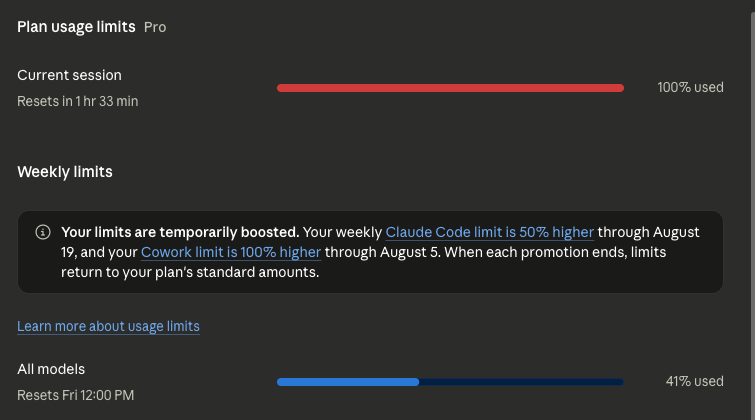
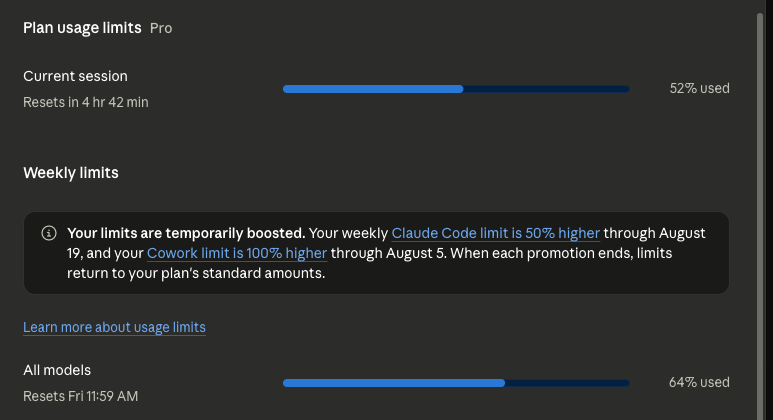
A percentage requires a denominator. I can see the numerator move in real time. I cannot translate the denominator into any unit I can use to plan the next piece of work.
That denominator may legitimately be dynamic and technically complicated. Model choice, effort level, context length, tools and research activity all change consumption, and Anthropic says so. The criticism is not that AI usage must be perfectly simple or perfectly predictable.
The criticism is that Anthropic does not translate that complexity into sufficiently decision-useful information before the customer commits time or money.
 Enlarge ↗
 Enlarge ↗
How Vaseline got into a CHI investigation
CHI exists partly to examine industries famous for customer-hostile pricing — baggage fees, carrier surcharges, cable's miscellaneous-fee art form, Ticketmaster watching a ticket price mutate during checkout. I despise these practices. But in fairness to all of them, they generally tell me what they are charging me for.
At least airlines, mobile carriers, cable companies, and Ticketmaster are wearing a condom while they are fucking me in the ass. Anthropic is raw-dogging me with no Vaseline.1
Crude? Absolutely. But someone who has never used an AI product can understand the commercial complaint from that analogy alone. The traditional masters of nickel-and-diming customers generally identify the nickel and what it buys.
Anthropic has managed to nickel-and-dime me without telling me what the nickel buys.
“And since we have arrived at Vaseline, consider the product itself.”
This is the point at which a deliberately absurd comparison became an accidentally useful one. Vaseline sells me a finite quantity. The quantity is printed on the container. I can visually inspect how much remains. I can estimate my consumption rate, determine whether I have enough for whatever regrettable project I have planned, and decide when another container is necessary.
| A jar of Vaseline | Claude |
|---|---|
| Finite quantity | Finite capacity |
| Quantity stated on the container | Displays percentage used |
| Remaining quantity can be inspected | Remaining percentage can be displayed |
| Customer can estimate whether more is needed | Customer lacks a similarly useful translation into the next planned workload |
When I have consumed 100% of my Vaseline, I know exactly what “100%” means.
The fucking jar has a denominator.
The petroleum-jelly industry has therefore solved a customer-capacity transparency problem that one of the world's leading artificial-intelligence companies has not.
The joke is ridiculous. The economic comparison isn't.
1 See generally: Ice Cube, “No Vaseline,” Death Certificate (1991). ↩
Section 6 — Associated pattern
Intellectual Disrespect
Only now, with the evidence on the table, does CHI's framework have anything to say about it.
Intellectual Disrespect occurs when a company uses sanitized, condescending, or rectitudinous corporate language to explain business practices that are plainly at odds with reasonable customer expectations, often reframing a customer-negative decision as reasonable, necessary, or even beneficial. The disrespect lies in expecting customers to accept the framing instead of recognizing the contradiction for themselves.
Perfect prediction is not required. The classification does not ask a company to promise an exact number, and it is not defeated by the fact that consumption genuinely varies. It asks whether the company converted what it can measure into something the customer can decide with.
Disclosures that could materially improve the decision include:
A band rather than a number — "this is likely to consume 30–60% of your current session."
What this customer's comparable past work actually consumed.
A flag before dispatching an operation likely to be unusually expensive.
A prospective estimate for a task already scoped, expressed against remaining capacity.
What the same task would cost at a different model or effort level.
An honest confidence interval, including how wide the company's own uncertainty is.
This classification must remain falsifiable. Meaningful customer-facing estimates, warnings, or planning tools could materially weaken or defeat it. If Anthropic already provides such a mechanism and CHI has failed to find it, the classification should be withdrawn — and that is one of the questions Anthropic is being asked.
Section 7 — The explainer
I Have to Spend Claude to Find Out Where I Spent Claude.
Claude pointed me at /explain-usage, a mechanism that retrospectively analyses the session and reports where the effort went.
It worked. It is a genuinely useful piece of engineering, and it is more transparency than most companies offer about anything.
Then Claude told me something about it that I have not been able to verify: that generating the explanation itself travels through the same metered pipeline as an ordinary request. Loading the tools, reading the logs, running the calculations and writing the answer are not, on Claude's account, specially exempt.
Claude-reported · not independently verified
We do not know how—or whether—that computational activity maps onto Anthropic's customer-facing session allowance, weekly allowance, or separately billed usage.
The explainer also reported a roughly 72% / 28% split of "weighted actual cost" within that session. CHI does not present that figure as equivalent to subscription billing or to the customer-facing session meter, because nothing available to the customer establishes that relationship. What "weighted actual cost" means is a question for Anthropic.
Section 8 — Limits of this investigation
What We Are Not Claiming
A single documented customer experience supports some conclusions and not others. These are the ones it does not support.
- That Anthropic intentionally designed the system to make customers overspend.
- That every Claude Pro customer experiences comparable capacity exhaustion.
- That 25 minutes represents typical Claude Pro capacity.
- That Claude secretly possesses Anthropic billing information.
- That
/explain-usageconsumes a specific percentage of the customer-facing allowance. - That Anthropic violated customer-protection law.
- That Claude is a bad product.
- Claude is an excellent product. I pay for it deliberately, I chose it over the alternatives for this work, and it earned a significant place in my professional workflow. That is why the usage question matters enough to investigate.
Section 9 — Remedies
This Is Fixable.
None of the following requires perfect prediction, and none of them requires Anthropic to give anything away.
Show me what my own recent sessions actually consumed.
Give me a band before I commit, not a receipt afterwards.
Tell me when I am about to dispatch something unusually heavy.
Show me what the same task costs at a lower model or effort level.
Tell me when conversation length is what is making this expensive.
Or any equivalent planning measure behind the percentage.
Before I buy credits, an approximate sense of what they will accomplish.
I don't need unlimited Claude. I need a budget.
Section 10 — Right of reply
We Have Questions for Anthropic.
Anthropic is invited to review the factual questions, correct errors, and provide technical or commercial context. Any substantive response will be represented fairly on this page.
- Response status
- No substantive response publishedThis page will be updated if Anthropic provides a response or correction.
- Right of reply
- OpenAnthropic may respond to any factual statement or question below.
- Publication status
- PublishedCHI restored this investigation to public access on September 21, 2026.
View questions for Anthropic
Anthropic is invited to respond to the following factual questions. Any substantive response will be represented fairly in this investigation.
- What quantity is represented by the customer-facing “100% used” session meter? What is the denominator against which that percentage is calculated? If Anthropic does not disclose that denominator, why not?
- Can that denominator be translated into any customer-comprehensible unit—for example tokens, weighted tokens, compute, approximate API-equivalent cost, or another measure? If no such translation is technically meaningful, please explain why.
- Anthropic states that usage varies according to factors including model choice, effort level, conversation/context length, features, tools, and Research activity. What information does Anthropic provide before execution that allows a customer to estimate the effect of those choices on remaining capacity? If Anthropic provides no such estimate, please confirm that.
- Before execution, can Anthropic's systems estimate—within a range rather than with exact precision—the likely consumption of a planned Research or other computationally intensive operation? If Anthropic cannot do so, what technical limitation prevents it?
- Does Anthropic internally forecast or estimate workload consumption for any purpose, including infrastructure provisioning, inference scheduling, capacity management, cost management, rate limiting, or billing? If so, why can't any useful form of that information be exposed prospectively to the customer?
- During the documented session, Claude was operating with Opus 5 at High effort and ultimately dispatched ten research agents. What information available to the customer before execution would have indicated approximately how much of the remaining session allowance that configuration and workload might consume?
- Does
/explain-usageitself consume any portion of a customer's session limit, weekly limit, additional-usage balance, or other metered allowance? Claude told me that it travels through the same metered pipeline as an ordinary request. Is that statement accurate? Please distinguish among the different limits or balances if the answer differs. /explain-usagereported approximately 72% of “weighted actual cost” attributable to Claude's instructions and 28% to analysis in the documented session. What does “weighted actual cost” mean? How, if at all, does that measurement relate to the customer-facing session and weekly usage percentages?- When included capacity is exhausted and a customer enables separately billed additional usage, what information can the customer use before spending money to estimate what a given dollar amount will accomplish? Can a customer determine, even approximately, whether $5, $50, or $250 will be sufficient to complete a planned workload?
- Does Anthropic measure the percentage of Pro or Max subscribers who exhaust included capacity and subsequently use separately billed additional usage? If so, does Anthropic disclose that figure publicly? We are not asking Anthropic to disclose confidential financial information; if it cannot provide the figure, please say so.
- Has Anthropic studied whether uncertainty about remaining capacity affects customers' decisions to purchase additional usage, upgrade plans, defer work, or stop using Claude? If so, has Anthropic published any findings?
- Has Anthropic considered displaying prospective consumption estimates, ranges, burn rates, historical task consumption, or warnings before unusually expensive operations? If so, what was the outcome? If not, why not?
- Does Anthropic disagree with the investigation's characterization that a customer can know the percentage of an allowance already consumed while lacking a practical way to estimate what a planned workload will consume before beginning it? If Anthropic disagrees, what existing customer-facing mechanism provides that information?
- Does Anthropic dispute any factual statement in the attached investigation? If so, please identify the specific statement, explain why it is incorrect or materially misleading, and provide the information Anthropic believes should replace it.
The document
This page contains the evidence and the argument.
The complete published investigation appears on this page, with its supporting exhibits embedded throughout.
Published investigation
Anthropic, How Stupid Do You Think Your Customers Are?
Approximately 20 pages, with citations to Anthropic's own documentation, the complete evidentiary record, and the adversarial audit that narrowed the claims on this page.
The complete web investigation is public. Supporting exhibits appear throughout the page.
Section 11 — The remaining question
Anthropic built one of the smartest products I have ever used.
It can measure consumption precisely enough to stop included usage at 100%. It can sell additional consumption and meter that consumption against actual dollars.
So the remaining question isn't whether usage is complicated.
Are customers confused because Anthropic's usage economics are genuinely too complicated for one of the world's leading artificial-intelligence companies to explain—or is that confusion commercially useful?
Intent has not been established. Anthropic remains invited to explain the system, correct the record, or respond to the published questions.