CHI Company Comparison · Artificial Intelligence
OpenAIvs.Anthropic
What Does $200 of AI Actually Buy?
Two frontier-AI companies sell premium access in ratios. Customers receive percentages, reset clocks and precise prices for exceeding their plans—but no stable denominator for the access they bought.
When a paying customer buys premium AI access, what can the customer know, predict, control and recover—and how do OpenAI and Anthropic differ in making those things possible?
2 September 2026
A five-hour allowance, an interrupted research run, and a second session spent recovering it.
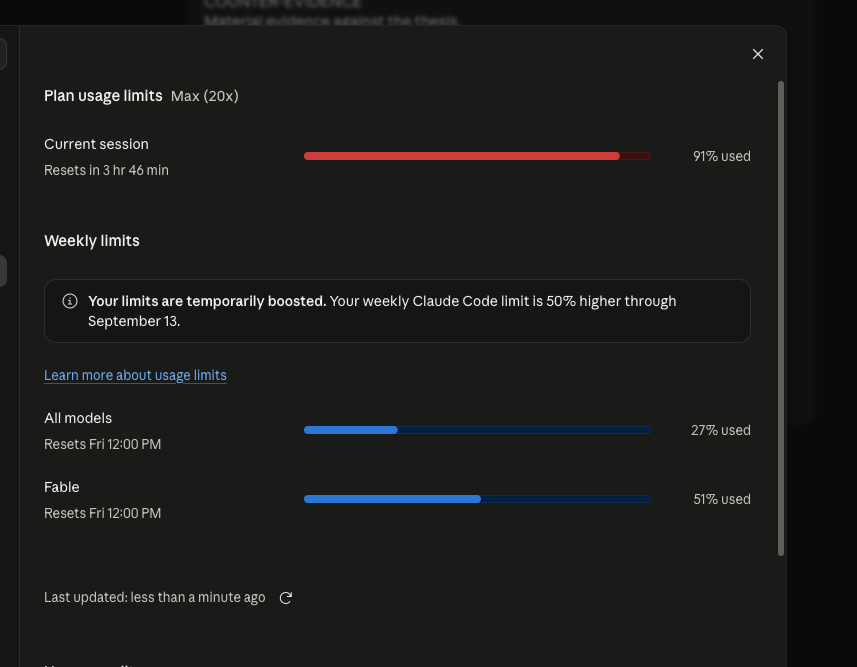
At 10:04 a.m. on 2 September, a Claude Max 20x account showed 91% of its current-session allowance used. Its all-model weekly meter stood at 27%. Its Fable weekly meter stood at 51%.
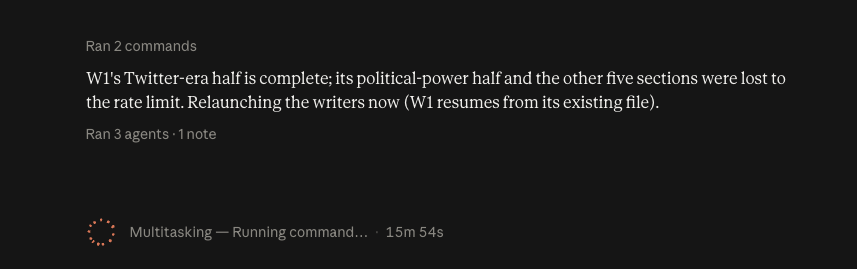
Four hours later, Claude reported that one research section had survived but “its political-power half and the other five sections were lost to the rate limit.” It then relaunched the writers. The interface showed three agents running.
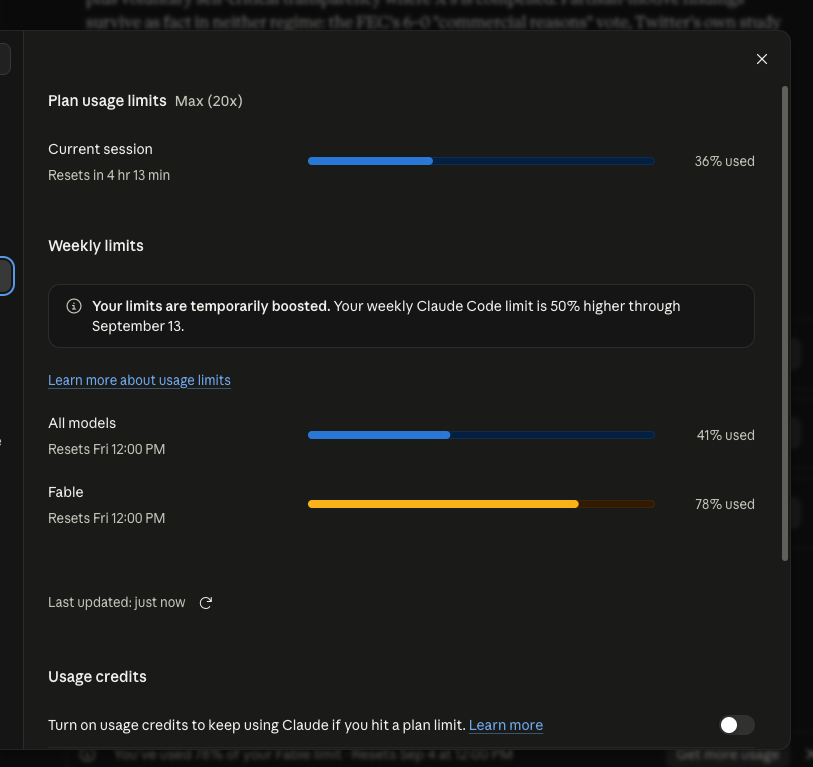
By 2:37 p.m., the new session was already 36% consumed. The weekly meter had risen to 41%, Fable to 78%, and the interface was offering usage credits.
The arithmetic is more revealing than any single percentage. The first session reached its limit; the replacement session then consumed another 36%. That implies roughly 136% of a session allowance spent on one research operation. Even if we refuse the interface’s report that the first session had fully exhausted and count only what the screenshots independently prove, the floor is 127 percentage points: 91% before the interruption, plus 36% after it.
Some of that second-session usage created new work. Some restored progress that did not survive the interruption. The interface did not distinguish between the two.
That is the central problem in premium AI subscriptions. A customer can see exactly how much of an allowance has vanished, yet still cannot answer the practical question the allowance exists to answer: Will it carry this job to completion?
The invisible denominator
Both companies sell a multiple. Neither publishes the number it multiplies.
OpenAI and Anthropic have built different systems around the same commercial omission. Each sells premium access as a multiple of another plan—5x, 20x, or similar—without publishing a stable underlying quantity. Each measures consumption after the fact. Each offers paid relief when included access runs out. Neither gives the customer a dependable pre-task estimate or a published recovery entitlement when platform limits interrupt ongoing work.
A percentage of an undisclosed denominator is retrospectively exact and prospectively meaningless.
The product is a ratio
Seven questions a paying customer should be able to answer.
Anthropic describes Claude Max in relation to Claude Pro: the lower Max tier offers five times Pro usage, and the higher tier offers twenty times. Pro itself is described as providing at least five times the usage available per five-hour session on Claude’s free service. These are ratios whose base is not disclosed as a stable number.
OpenAI uses the same structure for premium agentic access. ChatGPT Pro receives multiples of the usage available on Plus for Work and Codex. Plus is described through ranges, changing limits and product-specific rules rather than a single entitlement. OpenAI publishes useful proxy ranges for certain agentic models—an important disclosure advantage—but warns that these are not fixed message limits because cost depends on model and complexity.
The result is not that customers receive nothing. It is that the commercial unit being sold is missing.
| Customer question | OpenAIChatGPT Pro | AnthropicClaude Max 20x |
|---|---|---|
| What is the headline promise? | OpenAIHigher or “unlimited” access, plus relative multipliers on some agentic products | AnthropicMax 5x or 20x relative to Pro; Pro at least 5x Free |
| What is the base quantity? | OpenAINo single stable denominator across chat, Work, Codex, research, voice, files and images | AnthropicNo stable published base for Pro or Max usage |
| What can the customer see? | OpenAIProduct-specific meters, reset windows, remaining percentages or task counts | AnthropicSession and weekly percentages, reset times and model-specific sub-limits |
| How is usage organized? | OpenAIFragmented across surfaces and meter types; some agentic products share an allowance while ordinary chat does not | AnthropicA more unified usage pool, with overlapping session, weekly and model-specific constraints |
| Can the customer estimate a task before starting? | OpenAISometimes approximately, using model ranges; not reliably across the subscription | AnthropicNot reliably; usage varies with model, effort, features, context and task complexity |
| What happens at the limit? | OpenAIWait, switch modes where available, use a reset mechanism, or buy additional capacity in eligible products | AnthropicWait, switch models, reduce work, or use paid usage credits where available |
| Is interrupted work granted recovery capacity? | OpenAINo published general entitlement identified | AnthropicNo published general entitlement identified |
Severity styling marks where the customer is left without a usable answer, not a score. Neither company is assigned a CHI, CVI or CFS figure on this page.
This matters because a multiple is only informative when the reference quantity is known. “Twenty times” is not a capacity statement. It is a comparison to a moving and unpublished baseline.
Same blind spot, different architectures
One company fragments the answer. The other concentrates it.
OpenAI
Many meters, many reset clocks
OpenAI’s limits are fragmented. A customer may encounter an agentic allowance shared across Work and Codex; separate message limits for particular models; task allowances for deep research; rolling upload limits; voice-hour limits; and products described as unlimited subject to guardrails. Ordinary chats can sit outside the shared agentic allowance even when the products appear under one subscription.
That architecture makes the subscription difficult to reason about as a whole. A customer may have access remaining in one surface while a different meter blocks the job they are actually doing. Reset periods also differ. A five-hour window can coexist with a weekly window, so clearing one constraint does not necessarily clear the other.
Anthropic
One pool, several ceilings over it
Anthropic’s architecture is more unified, but not necessarily more legible. Claude usage is affected by model choice, effort, conversation length, web search, Research, artifacts and multi-step work. A customer can encounter a session limit, a weekly all-model limit and a model-specific weekly constraint at once.
Fable illustrates the ambiguity. Claude’s interface presents a Fable weekly meter as a separate limit. Anthropic describes it as a sub-cap: Max users may spend up to 50% of regular weekly usage on Fable, which also draws from the ordinary pool and burns it faster. The customer is spending one entitlement under an additional ceiling, at a rate visible only after consumption.
OpenAI therefore fragments the answer across products. Anthropic concentrates the answer in overlapping percentages. The customer problem is the same: visible gauges without a usable capacity forecast.
The meter knows the past, not the future
Exact about what is gone. Silent about what is left to do.
A strong usage meter should help a customer make a decision before cost is sunk. Neither company’s meter consistently does that.
If Claude says a session is 35% used, the number is exact about the past. It does not tell the user whether a planned multi-agent research run will require 20% or 80% more. If ChatGPT reports 99% of a shared agentic allowance remaining, that still does not say how much a repository analysis, spreadsheet operation or long research task will consume.
The technical reason for variability is credible. Long contexts, higher-effort reasoning, tools, searches, files, agents and model selection alter consumption. Exact task costs cannot always be promised in advance.
But technical variability does not explain the absence of ranges, task-class estimates or preflight warnings. OpenAI already publishes broad model-specific ranges for Work and Codex. Anthropic already publishes API prices and explains the factors that accelerate subscription usage. Both companies therefore possess the conceptual machinery to translate compute variability into bounded expectations. They generally choose not to apply it to the included subscription entitlement.
The informational asymmetry becomes sharpest at the boundary. Before the limit, included usage is described in flexible ratios and conditional language. After the limit, additional use can be priced with monetary precision.
What happened at the boundary
A documented field case on one Claude Max 20x account.
Three labels are used in this section. They are not interchangeable.
The 2 September Claude case does not prove that every rate limit destroys work. It documents specific operations on one Max 20x account.
The operation used multiple agents to produce a structured research dossier. At 2:05 p.m., Claude reported that five sections and part of a sixth had been lost to the limit. It relaunched writers, with one resuming from an existing file. Thirty-two minutes later, the renewed session had used 36%, and the interface offered credits.
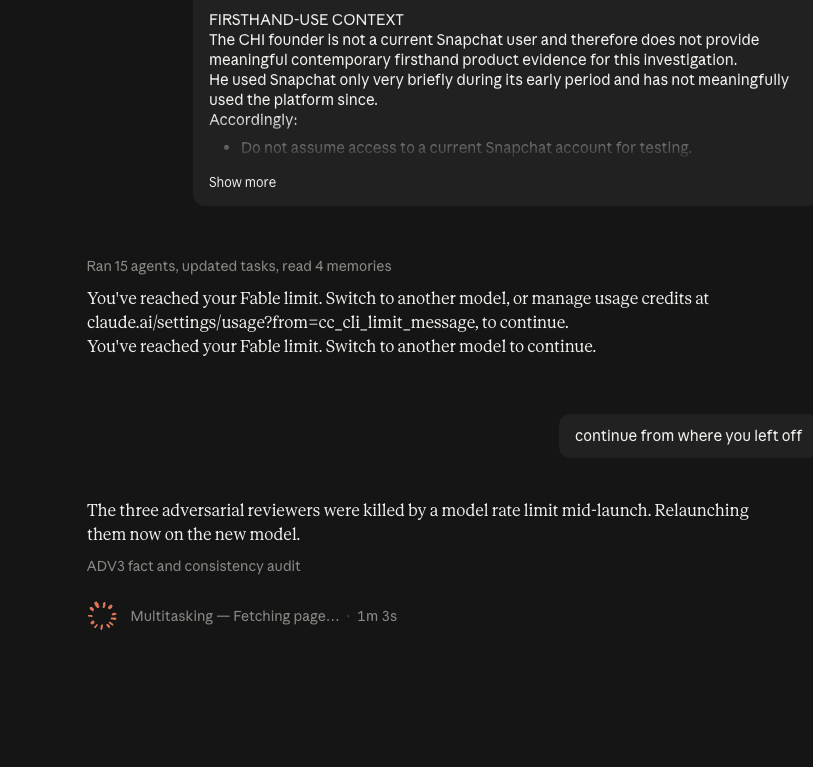
Later that day, a separate research operation hit the Fable boundary. Claude reported: “The three adversarial reviewers were killed by a model rate limit mid-launch. Relaunching them now on the new model.” The recurrence matters. The first interruption occurred at the session layer; the second at the model-specific Fable layer. Both converted platform interruption into further consumption.
Preserved captures — 2 September 2026
Screenshots are reproduced unaltered. Select any capture to open it at full size.
Session 91% used
Before the interruption
 Enlarge ↗
Five sections lost
Writers relaunched
 Enlarge ↗
New session 36% used
Credits offered
 Enlarge ↗
Fable limit reached
A separate research run
 Enlarge ↗
The record supports a narrow but important distinction:
Definition
Compute consumption
Usage that produces new work.
Definition
Recovery consumption
Usage spent restoring, reconstructing or repeating work that did not survive a platform interruption.
The customer can therefore pay twice in usage for one research objective—not necessarily through two credit-card charges, but through two draws on a finite entitlement: first to create work that does not survive the interruption, and again to reconstruct it.
Unresolved backend fact There are limits to what this evidence proves. The logs do not establish whether the missing work was inaccessible, unpersisted or discarded. They do not establish intent. They do not establish how often the behavior occurs across customers or workloads. A separate Adobe research operation continued and completed after its meter reached 100%, demonstrating that meter exhaustion does not universally produce work loss.
The interrupted run was later put on hold. A clean-room rerun corrected several substantive problems in its synthesis, including inflated bounded-negative findings, category drift and lost caveats. The interruption coincided with lost state and a defective synthesis that required replacement. The evidence does not establish that the rate limit caused every defect.
Supported inference Those caveats narrow the claim; they do not erase it. A premium plan marketed for longer, more complex work encountered a usage boundary during exactly that work. The system knew the remaining percentage. It did not protect the in-flight output, reserve recovery capacity or warn that the job was unlikely to fit.
The 201st dollar is clearer than the first $200
At exhaustion, the pricing becomes precise.
When included access runs out, both companies become more explicit.
Anthropic lets eligible customers enable usage credits, continue beyond the plan limit and set spending caps. Additional use is charged at standard API rates, with usage history available. OpenAI likewise sells capacity through credits or reset mechanisms in eligible products. Its instant reset restores five-hour and weekly availability immediately, but pulls future weekly allowance forward rather than adding entitlement.
These are useful controls. They are also the point at which a subscription’s ambiguity becomes commercially consequential.
The plan price buys a relative promise: more access than another tier, subject to workload-dependent consumption. The next unit of access is governed by a rate card, a checkout price or a credit balance. The companies can price marginal compute precisely enough to charge for it, while the included compute remains difficult to translate into tasks.
This is not evidence of deception by itself. Variable-resource services often combine subscriptions with metered overage. The concern is sequence and disclosure. A customer cannot reliably price a job before beginning it; the customer discovers the effective capacity while the job is underway; the point of failure can create recovery work; and the immediate remedy is more paid capacity.
The companies monetize relief from a limit the customer could not meaningfully model in advance.
Refund policies do little to resolve this. Anthropic describes paid plans as generally non-refundable except where its terms or law require otherwise, with a withdrawal route for some European and UK customers. OpenAI provides refund-request routes and jurisdiction-specific rights, but we found no published general promise to refund entitlement spent reconstructing work after a limit interruption. Neither company publishes a general recovery-credit policy.
That is a bounded absence, not proof that discretionary remedies never occur. The published contract simply does not let customers count on one.
What the companies get right
Evidence against the thesis.
The comparison is not a claim that all usage limits are hidden or all changes harm customers.
Both companies display usage meters and reset times, make paid overage opt-in, provide ways to cap additional spending and explain that consumption depends on workload. Both have increased limits or added capabilities without always raising the subscription price.
OpenAI
OpenAI goes further in some areas. Its agentic documentation publishes broad per-model task or message ranges, even while warning that they are only estimates. Some products use comprehensible units such as hours or research-task counts. Those disclosures demonstrate that variability can be expressed without pretending to certainty.
Anthropic
Anthropic publishes an unusually useful rule for Fable: the model can consume up to half of weekly usage, draws from the main pool and burns that pool more quickly. Its documentation explains which features raise consumption, and its credit system provides spending caps and usage history.
Neither company, however, carries those partial disclosures through to the customer’s core decision: whether the work about to be launched will fit, what will happen to in-flight work if it does not, and who bears the cost of reconstructing progress.
What fair disclosure would look like
Not a fixed message count. Usable uncertainty.
The answer is not a fixed message count: a one-line chat and a multi-agent dossier are not equivalent. The answer is usable uncertainty.
At minimum, premium AI plans should provide:
- A capacity range. Publish typical low, middle and high consumption bands for recognizable task classes, broken out by model and enabled tools.
- A preflight estimate. Before a long task or agent swarm begins, estimate whether it is likely to fit inside the currently available session, weekly and model-specific allowances.
- All applicable constraints in one view. Show which meter is likely to bind first and how consumption of one sub-limit affects the others.
- Boundary-safe persistence. Preserve completed and in-flight agent output when a platform limit is reached, with a clear account of what was saved.
- Recovery protection. Do not debit reconstruction work caused by a service-side limit, or provide an automatic recovery allowance.
- Advance notice of material denominator changes. If the practical capacity behind “5x” or “20x” changes, disclose the direction, effective date and expected customer impact.
- A usable remedy. Where a limit causes verifiable work loss, offer restoration, credits or a refund path designed for that event.
These changes would not require either company to reveal proprietary infrastructure or promise identical output from every task. They would require the companies to treat included compute as a product with an intelligible quantity, rather than a relative claim customers can understand only by exhausting it.
The comparison
OpenAI and Anthropic do not differ most in generosity.
They differ in how opacity is organized.
Without a stable denominator, generosity is difficult to compare. OpenAI divides usage among many products, units and reset systems, occasionally offering useful ranges inside that fragmentation. Anthropic presents a more coherent set of meters, but places multiple weighted constraints over the same pool. OpenAI’s customer asks which allowance applies. Anthropic’s customer asks what the percentage can actually accomplish.
In both systems, the customer is better equipped to audit yesterday than plan tomorrow. In both, the remedy at exhaustion is clearer than the entitlement that preceded it. And in neither does the published bargain reliably answer what happens when a paid limit interrupts work already in motion.
AI workloads are variable. That is an engineering fact.
Making the customer absorb the uncertainty without a forecast, preservation guarantee or recovery rule is a product choice.
CHI Principle
Variability does not require invisibility.
A company that can price the next unit of compute precisely can describe the included unit honestly.
Method and source note
What this page is based on.
This comparison is based on first-party product and support documentation from OpenAI and Anthropic, contemporaneous product-interface captures, and a documented first-hand Claude Max 20x field case. Product statements were checked through 21 September 2026. The field case establishes observed behavior in the recorded operations; it is not used to estimate prevalence.
Primary documentation reviewed includes OpenAI materials covering ChatGPT plan tiers, Work and Codex usage, shared allowances, weekly resets, banked and instant resets, flexible-use credits, model rate cards and deep research; and Anthropic materials covering Claude Max, usage and length limits, usage best practices, Fable access, usage credits and paid-plan refunds.
No regulator finding identified in this research declares either company’s subscription-limit design unfair or unlawful. Conclusions here concern customer knowledge, prediction, control and recovery—not legal liability, company intent or comparative model performance.
Company background is not repeated here. Each company holds its own separately published CHI assessment: the OpenAI / ChatGPT Special Investigation and the Anthropic Special Investigation.